Jazz and Hip Hop’s Response to 90’s Politics

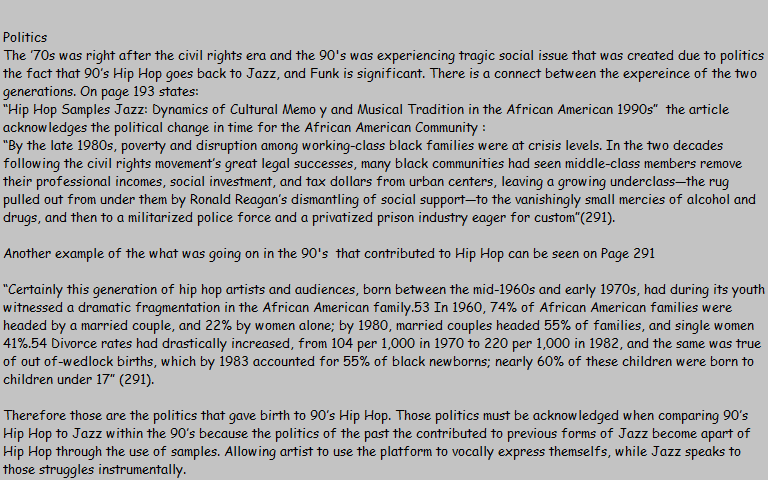
hip-hop-jazzDuring the late 1990s, African American communities across the nation were negatively impacted by the Prison Industrial Complex. The Prison-Industrial Complex is a national spectacle with a bestowed interest in economic and political power. African American and Latino men, women and children are incarcerated and utilized to maintain the Prison-Industrial Complex under a disguise as “the war on crime.” Also known as a “war on street crime”,  in reality, a war on people of color (Love). “Mass media works with elitist policy makers to shape and create public misperceptions which so desensitize citizens to the real issues that the targeted group is held with contempt or indifference” (Love). Recording artists, Tupac Shakur and Gang Starr’s Guru express their feelings regarding social misperceptions, institutional racism, and the history of jazz.

When listing closely to Gang Starr’s lyrics, one may notice Guru’s awareness of  misconceptions regarding “the war on crime”,  an actual war on disenfranchised minority communities. As a result, innocent lives of people of color feel the impacted through imprisonment facilitated by the Prison Industrial Complex or police brutality. Gang Starr uses an intersection between Jazz and Hip Hop to express their concerns regarding the political climate during their era. In addition, Gang Starr’s awareness of the history of jazz motivated Guru to create a new song, Jazz Thing.  Tom Perchard says, “In 1994 Gang Star’s Guru told Source Magazine that an unidentified “they” had t[aken] jazz and made it just for an elite crowd. They took it away from blacks”(283).

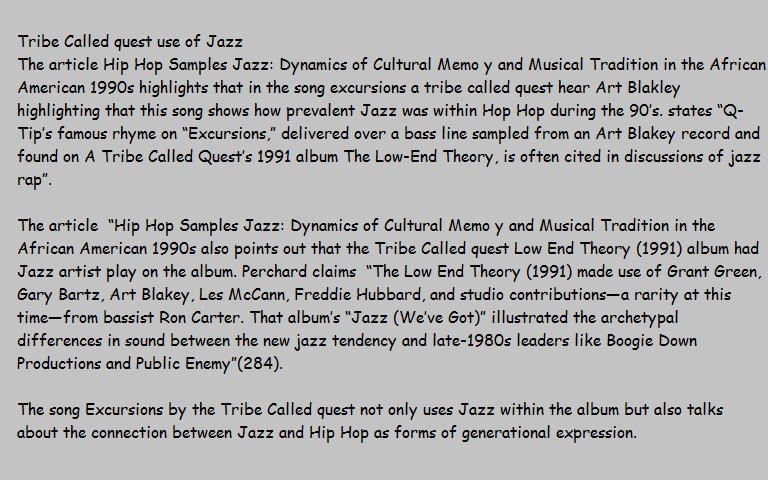
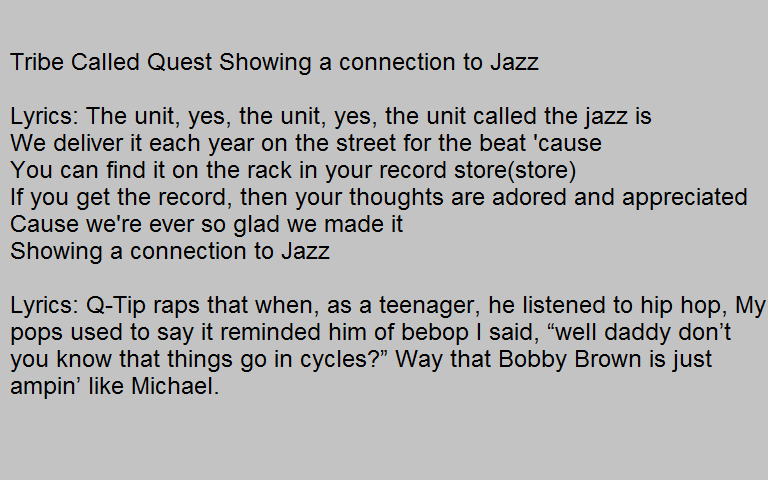
According to Tom Perchard, ” In 1989 Gang Starr ’s first album, No More Mr Nice Guy, featured the song “Jazz music,” in which Guru rapped a narrative history of the style over a patchwork of ramsey lewis and Charlie Parker; the group repeated the formula the following year for “Jazz Thing,” their (now much better-known) contribution to the soundtrack of Spike lee’s film Mo’ Better Blues. much of the music using jazz, however, was made by the various groups connected by collaboration, ethic, and dress style under the name Native Tongues—Jungle brothers, a Tribe Called Quest, De la Soul, Queen latifah, black Sheep—and it was a Tribe Called Quest who were most often associated with rap’s embrace of jazz sources” (285).

Tupac Shakur expresses his feelings through his music. Tupac responds to institutional racism, The Prison-Industrial Complex, and African American male victims who are impacted during the 1990s. Both artist utilize their jazz or hip hop platforms to raise awareness regarding the political climate during the 1990s.  Both artists appear to be concerned about how the political climate is effecting the African American community.

According to Karin L. Stanford, “Tupac’s lyrics underscore his refusal to accept economic inequality and inad equate employment opportunities. He also continues his attack on patriotic sym bolism. In 1992, Tupac discussed the unfairness of the capitalism on MTV: “Because I feel like there’s too much money here. Nobody should be hitting the lotto for 36 million and we got people starving in the streets. That is not idealistic, that’s just real” (7). As you will see in the last Tupac video below, Tupac was far more intelligent than the media portrayed him to be. In addition to rapping  and acting, Tupac used activism to convey his vision for positive change for African American communities.

Work Cited

Love, Michael J. , “The Prison-Industrial Complex: An Investment in Failure,” May 1998. In Let Nobody Turn Us Around: Voices of Resistance, Reform, and Renewal; An African American Anthology, edited by Manning Marable and Leith Mullings, 622-623. New York: Bowman & Littlefield Publishers, Inc., 2000.

Perchard, Tom. “Hip Hop Samples Jazz: Dynamics of Cultural Memo Y and Musical Tradition in the African American 1990s.” American Music 29, no. 3 (2011): 277-307. doi:10.5406/americanmusic.29.3.0277.

Sanford, Karin L. “Keepin’ It Real in Hip Hop Politics: A Political Perspective of Tupac Shakur.” Journal of Black Studies 42, no. 1 (2011): 3-22. http://www.jstor.org/stable/25780789.

News, MTV. Tupac Talks Donald Trump & Greed in America in 1992. April 19, 2016. Accessed March 10, 2019. https://www.youtube.com/watch?v=GL-ZoNhUFmc.

fgtory, Anonymous. Guru – Life Saver, YouTube, 24 Nov. 2010, http://www.youtube.com/watch?v=O4ijwSD6tEQ.

Ghiani, Enrico. Mo’ Better Blues , Enrico Ghianiube, 27 Dec. 2009, http://www.youtube.com/watch?v=Q1VREP-5Rg8.

Lenada, Alex. Gang Starr – Jazz Thing (Official Video) , Alex Lenada, 8 June 2018, http://www.youtube.com/watch?v=3kg0mh3lu9Q.
tesfaye10. 2pac: They Don’t Give A F**k ‘Bout Us, YouTube, 31 July 2006, http://www.youtube.com/watch?v=YItXQTyD_48.
Tupac – Life Goes On, YouTube, 22 Sept. 2005, youtu.be/W69SSLfRJho.

Hip Hop, Bebop’s Successor

Fab 5 Freddie (Born Fred Brathwaite), is an American filmmaker, and visual artist, and one of the first rappers to have pioneered the genre of hip hop. He simply started by making some beats and writing casual lines with a DJ friend of his, so as to perform at street block parties in Brooklyn. Freddie’s godfather, Max Roach, is one of the first links that tie together the genres of jazz and hip hop. When Freddie’s father (also a big jazz fanatic) told Max what his son was up, Max became interested right away. He went over to Freddie’s friends house and recorded some music with them, and later even appeared on a live television show with Fab 5 Freddie. He was very encouraging of Freddie’s art, which he himself at the time did not even consider music, and has since compared the innovations that are being made in hip hop, to those made by the early beboppers such as Bird and Dizzy. For Max, hip hop is a way to reinstitute an African consciousness in African American music.

“Max said ‘…you know western music has for a long period of time been a balancing of three different things: melody, harmony and rhythm in equal ways. As black folks have been involved in music we’ve added an increasing emphasis on the rhythm element throughout the development of this music.’ …. He said ‘what you guys are doing is just totally rhythm…'”

Hip hop and jazz are a part of the same continuum of African American music. The fact that Max Roach was aware of this so early is a testament to his intelligence and great sensitivity as a musician.

Max Roach believed that the development of rap and hip hop culture relates to a decline in funding for arts and music programs in schools, which meant that all of a sudden, children who were interested in music, didn’t have the opportunity to learn an instrument. As a result, this creative energy was redirected in a more raw approach to music, eventually giving rise to the genre of hip hop and rap.

Another jazz musician who is very aware of the ties that the music shares with hip hop, is Miles Davis. His later work incorporates a lot of elements of hip hop, such as the backbeat played on the drums, the rhythms and instrumentation more closely associated with hip hop, and as is the case with the song Doo Bop, even rapping itself. In fact, it was Max Roach who first introduced Miles to the hip hop and rap scene, when he showed him Fab 5 Freddie’s show “Yo MTV Raps”, the first television show that acted as a platform to feature hip hop and rap acts.

https://jazztimes.com/columns/independentear/fab-5-freddy-the-max-roach-influence/

A jazz upbringing @ the roots of hip hop

Drug abuse and violence

As the son of jazz and blues musician Olu Dara, hip hop artist Nas has evidently received inspiration for his music from his ancestral roots. Born in Brooklyn and later raised in Queens, New York, Nas understood the grisly circumstances that black communities faced during the 1990s such as the drug war, gun violence between African Americans, and gender inequality. For example, in his song “I Gave You Power,” the narrator personifies himself as a gun and depicts the rampant violence within black communities:


Here he highlights the divisive nature of gun violence and essentially trap black communities in a perpetual cycle of violence within America’s larger racist institutionalism. Nas noted that the prevalence of guns during his upbringing in Brooklyn compelled him to create a song about violence and express anguish behind it because of the devastating amount of deaths behind handheld firearms within black communities.

Marvin Gaye in his hit “What’s Going On” also looks at the injustices of poverty, drug abuse, and racism but from the perspective of a veteran returning from the Vietnam war. In particular, his label Motown was hesitant to release the song in that it might alienate some white listeners and would receive backlash because of its large political statements. Gaye responded by claiming to not record any more songs until “What’s Going On” was released. After several months of stagnant stalemate, Motown released the song in January 1973.

He later collaborated with Olu Dara in “Bridging the Gap”. The song itself notably has distinct features that tie back to blues tunes, clearly inspired by his father’s jazz roots, illustrating “the continuities between urban styles and agrarian forms” (Neff 161). Hailing from Mississippi, Olu Dara’s skill in adapting to various genres of music such as hip-hop shows the musical versatility that jazz offers. The significance of black history in America is shown through the lyrics:

“The blues came from gospel, gospel from blues / Slaves are harmonizin’ them ah’s and oh’s”

Not only does jazz open up new opportunities for younger artists to grow, but it also emphasizes that African Americans will forever pay homage to their roots and history. Nas describes his music as “the child of [his father’s] music”, yet this aptly defines hip-hop being the descendant of jazz music (Dreisinger).

Dreisinger, Baz. “Nas and His Dad’s Jazz.” Los Angeles Times, Los Angeles Times, 5 Dec. 2004.

Gaye, Marvin. “What’s Going On.” What’s Going On. Retrieved from https://www.youtube.com/watch?v=H-kA3UtBj4M

Nas. “I Gave You Power.” It Was Written. Retrieved from https://www.youtube.com/watch?v=eUwJ8WcZ6RY

Nas. “Bridging the Gap.” Retrieved from https://www.youtube.com/watch?v=hq7z3JBKCTE

Neff, Ali Colleen, and William Ferris. “Musical Mobilities.” Let the World Listen Right, 2009, pp. 141–168.

The Intersectionality of Jazz Hip Hop & Feminism

THE INTERSECTION OF JAZZ HIP HOP & FEMINISM
March 10, 2019 — Leave a comment

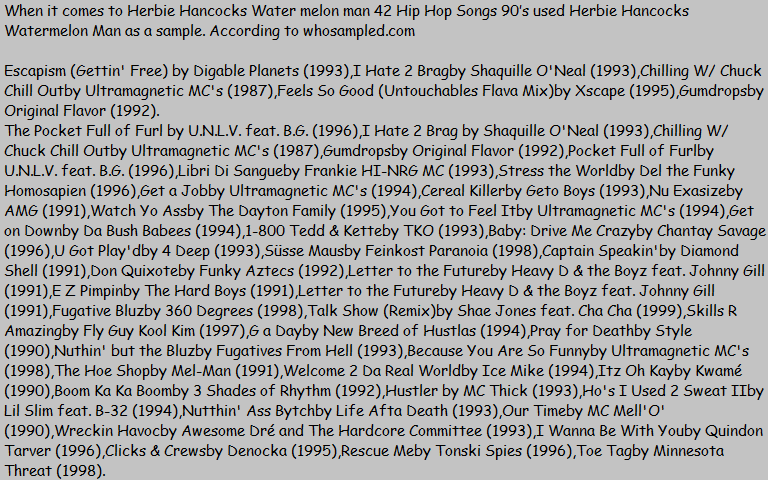
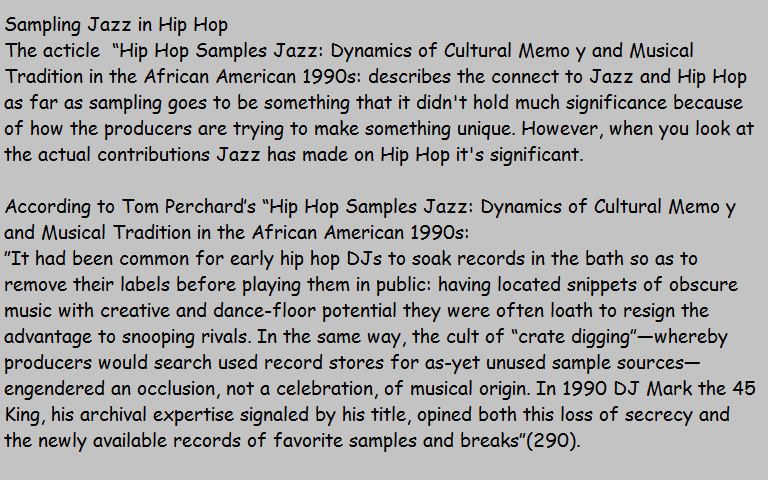
Hip Hop in the 90’s exposed listeners to an experimental intersection of various genres of music. In the beginning of Hip Hop both artists and engineers experimented with the sampling of chords, break beats, and harmony provided by jazz, funk, swing, and blues musicians. By piecing together beat fragments over hip hop styled beats artists were able to create a new sound and style of music. Many critics have argued that beat sampling is not music but something else, because there are no real instruments being played. Since the inception of music it has been in a continuous state of transformation and reinterpretation. The influence of jazz on hip hop music goes far beyond just the music it also influenced the lyrical style. In the song “U.N.I.T.Y.” rapper Dana Owens or “Queen Latifah” uses the smooth sound of the saxophone to emphasize the strength in her delivery of lyrics. The Feminist chants of the song was a cry for representation in a male dominated industry. The 90’s infused the African-American communities with crack cocaine, mass incarceration, domestic violence, and the political confines of the three strikes law imposed by President Bill Clinton. During the 90’s Queen Latifah addressed the social and political obstacles of representation and treatment faced by women. Latifah boldly confronts unacceptable domestic behaviors and politics on behalf of women who did not have the courage to confront their domestic abusers. Latifah’s aggressive outcry challenges the male dominated system and industry of rap music and offers representation for the unrepresented.

Eleanora Fagan or as she’s commonly known as Billie Holiday also faced the same obstacle during the 30’s and 40’s in the jazz industry. Despite being exposed to a male dominated jazz industry Lady Day used her music to address her political and social concerns. Although Lady Day addressed her concerns with class and grace lyrically Queen Latifah aggressively challenges those same concerns through her lyrics. Lady Day was know to physically fight men even her abuse husband Louis McKay a mafia enforcer. Still socially Billie Holiday faced the same social obstacles as Latifah such as drugs (heron), mass incarceration, and discrimination against black women.

Queen Latifah collaborated with an English artist Simone Johnson also know as “Monie Love” with a women anthem titled “Ladies First”. The song was a big hit just as “U.N.I.T.Y.”, both confronting the male dominated image of hip hop offering a strong but feminine approach to the genre. Queen Latifah and Billie Holiday shared different approaches to confront inequality, Latifah took a more aggressive lyrical approach while Lady Day took a sultry approach, both still addressing the discrimination and domestic violence women face. The music is still reports to the people because it is a representation of the people.

Cited Information:Jazz and Hip Hop’s Response to 90’s Politics

Queen Latifah “U.N.I.T.Y.” Performed by Dana Owens. U.N.I.T.Y. October 7, 2009. Accessed March 9, 2019. http://youtu.be/f8cHxydDb7o.

“The Last Days of Billie Holiday.” A Trip Down Memory Lane. March 9, 2012. Accessed March 9, 2019. greatentertainersarchives.blogspot.com.